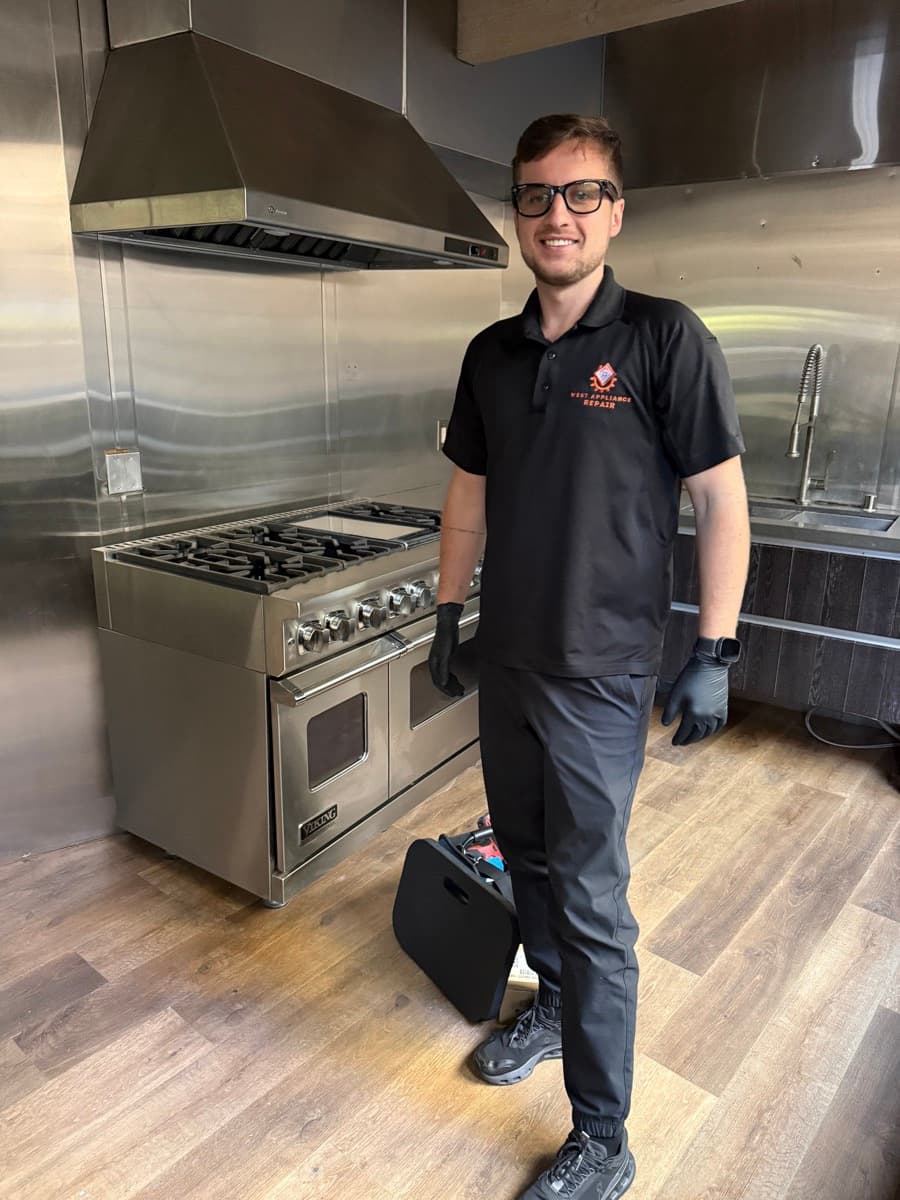
By West Appliance Service ·
Why a Viking igniter keeps clicking
On Viking sealed-burner ranges and rangetops, each burner has a spark electrode. On many models, every electrode sparks at once when any knob is turned to light. Clicking that continues after the flame is lit, or clicking with every knob off, usually comes from one of three causes. Water, cleaning spray, or a boilover may have soaked the area around an electrode or under the burner base. A burner cap may be off-center, so the flame does not sit close to the electrode and the system keeps trying to light it. Or a spark switch behind a knob may be wet or worn and stuck in the on position. Moisture is the most common cause, and it often clears up once everything dries. Clicking that lasts for days, happens with all knobs off, or started after liquid got behind the control panel usually means a switch or spark module needs replacement.
Safe checks for a clicking burner
Start with every knob off and the cooktop cool. Before you touch the electrodes, unplug the range or switch off its circuit breaker, because the spark system carries high voltage. Lift off the grates and burner caps. Wipe the caps, burner bases, and white ceramic electrodes with a dry cloth, and use a soft toothbrush to remove crusted food from the electrode tip. If the area got wet, leave the caps off for several hours or dry it with a hair dryer on a low, cool setting. Do not spray cleaner directly onto the cooktop near the knobs, since liquid can run down into the switches. Reseat each cap so it sits flat and centered on its base, with no rocking. Then confirm that every knob turns fully back to off. Restore power and test one burner at a time.
Weak, uneven or yellow burner flames
A healthy flame on a natural gas burner is mostly blue, with even, steady cones all the way around. If one burner has gaps or low spots, the ports are usually clogged with food or cleaning residue, or the cap is misaligned. With the burner cool, clear the ports using a straightened paper clip or a sewing needle. Avoid toothpicks, which can break off inside. Never enlarge the holes. If every burner is weak at once, the cause is more likely upstream. A partly closed shutoff valve, a regulator problem, or an issue with the home's gas supply can all reduce pressure. A yellow, sooty, or lifting flame points to poor combustion. That can come from an air or orifice problem, especially after a conversion between natural gas and propane. Stop using a burner that burns this way, because poor combustion can produce carbon monoxide. If you smell gas, do not touch light switches or controls. Leave the house and call your gas utility from outside.
Viking oven not heating
Many Viking gas ovens use a hot surface igniter, sometimes called a glow bar. It heats up and opens the gas safety valve once it draws enough current. Over time the igniter weakens. It may still glow but never get hot enough to open the valve, so the oven stays cold or takes a long time to light. Before assuming a part has failed, check the basics. The range needs electricity to light the oven, so make sure it is plugged in and the breaker has not tripped. Confirm that a timer, delayed start, or Sabbath-type setting is not active. Make sure the door is not still locked after a self-clean cycle. On electric or dual-fuel ovens, look for a bake element that is blistered, cracked, or visibly burned. Do not test an igniter or element with the power on. Replacing a gas oven igniter or valve involves gas connections, so it is a job for a qualified technician.
When to stop and call a technician
Some Viking range problems are reasonable to handle yourself, and others are not. Cleaning burners, drying electrodes, reseating caps, and checking breakers and settings are all safe homeowner tasks. Call a technician if clicking continues after the cooktop has fully dried, or if you see scorched wiring or melted connectors. Also call if the oven glows but will not light, the oven temperature runs far off, or a burner flame stays yellow or lifts off the ports. Any smell of gas calls for leaving the house first and getting help from outside. The same applies if you suspect a gas leak at a fitting, or if a control board, spark module, or gas valve may be involved. These repairs require proper gas leak testing, the correct replacement parts, and care with high-voltage components. A professional can also check the regulator and gas pressure.
Common questions
Why does my Viking stove keep clicking after I clean it?
Water or cleaner has usually reached the spark electrodes or the switches behind the knobs. Turn off power to the range, remove the burner caps, and let everything dry for several hours or use a hair dryer on a cool setting. Reseat the caps evenly. If the clicking continues once the cooktop is dry, a spark switch may need replacement.
Why do my Viking burners work but the oven won't heat?
The burners and the oven use separate ignition systems. On many gas ovens, a worn hot surface igniter is the usual cause. It glows but cannot open the gas valve. First check the breaker, any timer or delayed-start settings, and whether the door is still locked after self-clean. Then have a technician test and replace the igniter.
Is a yellow flame on my Viking range dangerous?
It can be. A mostly yellow, sooty, or lifting flame signals incomplete combustion, which can produce carbon monoxide. The cause may be dirty burner ports, a misaligned cap, or an air or orifice problem, often after a gas conversion. Stop using that burner and ventilate the kitchen. Have a technician inspect it. If you smell gas, leave and call your utility.
Many clicking and flame problems clear up once you dry the cooktop, clean the ports, and seat the caps properly. Worn igniters, faulty switches, and gas valve problems need professional repair. If your Viking range keeps acting up, call West Appliance Service at (877) 775-4968. We are open 24/7. The $95 diagnosis is credited toward the repair, and our work carries a 90-day standard warranty, with 18 months for HomeCare members.